It is 4:40 on a Tuesday. A regional training manager calls about your small boardroom for Friday. Ten people, half a day, nothing complicated.
Your sales manager takes the details, checks the calendar, builds a quote, sends it Wednesday morning, follows up Thursday. Thursday afternoon the answer comes back. They booked the hotel down the street.
Everyone did their job well. The booking still left.
Now run that Tuesday again. Same call, except the boardroom priced and confirmed itself in four minutes, and your sales manager spent the afternoon on the 250-person annual conference that has been sitting in your pipeline for three weeks.
Same team. Same building. Two more bookings.
That second version is available to most hotels right now, and it does not require new headcount or a bigger marketing budget. It requires deciding, room by room, which spaces need a salesperson and which ones never did. That is the two-speed framework, and it fits on one page.
You Are Running Two Sales Motions Through One Process
Every inquiry that reaches your sales inbox is one of two animals.
Transactional. A boardroom for ten. A day meeting for a corporate account you have hosted eleven times. A training room by the hour. These want availability and a price. A salesperson adds delay, not value.
Consultative. A conference with three breakouts and a gala dinner. A wedding block. A multi-day program where the room is the smallest thing you are selling. These want a person to shape the event and close it.
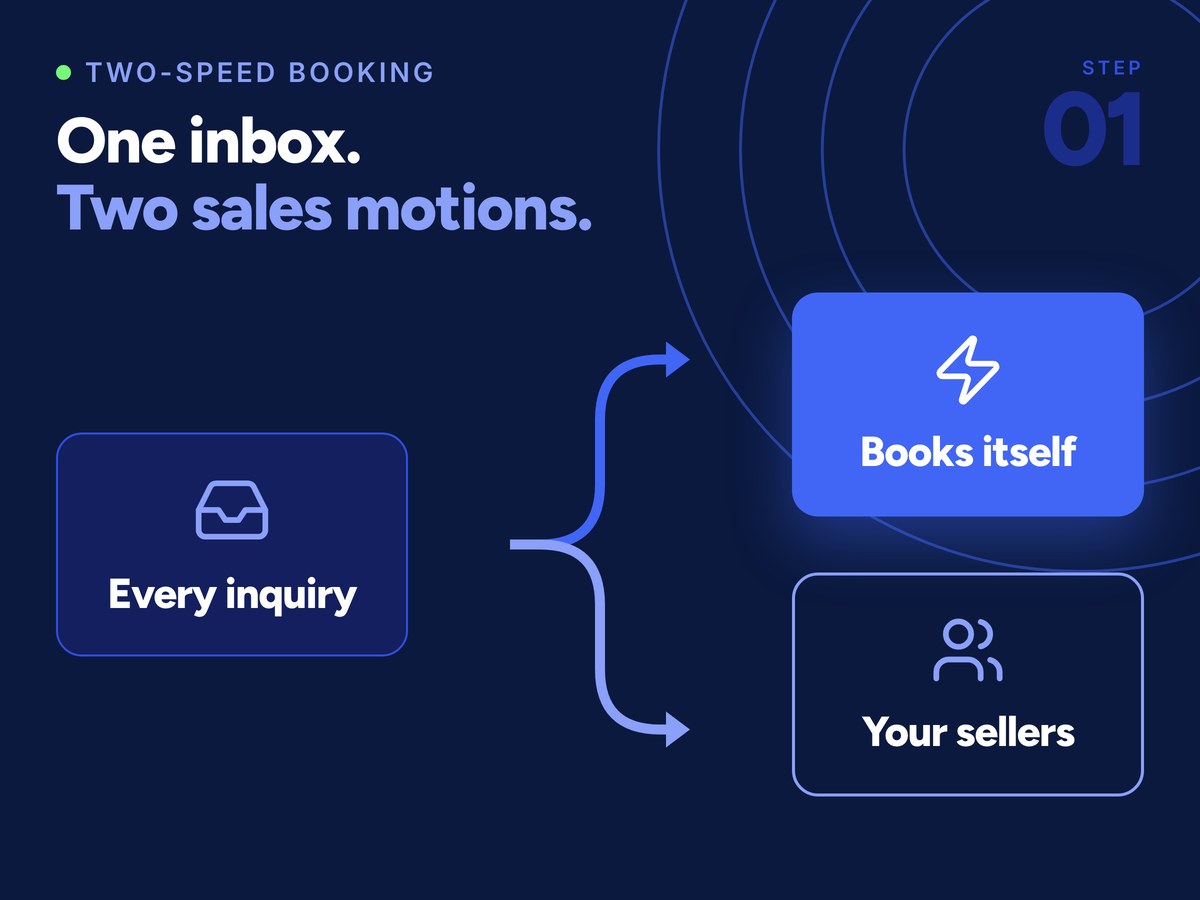
Most hotels put both through the same funnel. The consultative inquiry gets the process it deserves. The transactional inquiry gets the same process, at the cost of the one that needed it.
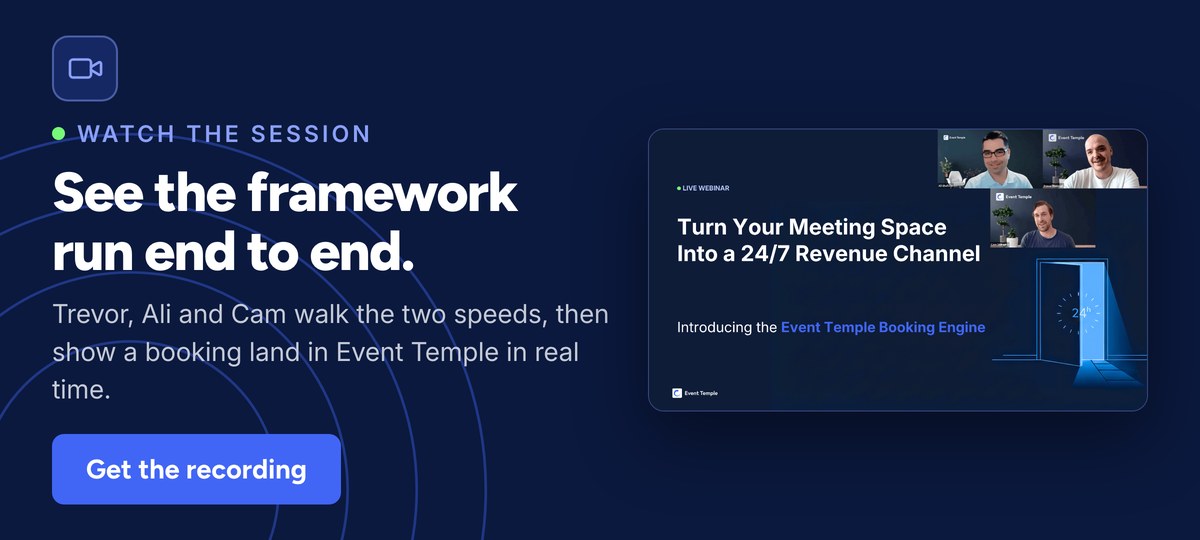
We put this to a room of hotel sales teams during our Turn Your Meeting Space Into a 24/7 Revenue Channel webinar in June. Asked how many meeting and event inquiries they field in a week, 51% said five to fifteen, 25% said fifteen to forty, and 16% were handling more than forty. Only 8% were under five.
So more than nine in ten are fielding at least one inquiry per working day, and four in ten are fielding several. Every one of those currently costs a person's attention, whether it deserves that attention or not.
Your sellers are trained to sell the event. Right now a good share of their week goes to quoting $500 boardrooms.
Growing Meeting Space Revenue Without Adding a Salesperson
There are only three ways to grow meeting space revenue. Raise rates. Add hours. Or convert more of the demand already reaching you.
The third one is where the room is, and it splits into two pieces that most properties never separate.
The demand you see and lose to speed. Roughly 75% of RFPs go to the fastest responder. On transactional business, "fastest" is no longer measured in hours.
We asked that same room how a guest can book a small meeting room at their property today. The answers were blunt: 44% email or call, 45% a website form, 4% request to book online. Seven percent could take an instant booking against live availability.
Nine in ten hotels still put a human step between a ready buyer and a small, simple room. That is the gap.
The demand you never see at all. A planner ready to commit on a Sunday evening finds no way to commit. They book someone else. That booking does not appear in your reports as a lost lead. It does not appear at all.
Both are addressable with the same move: let the right spaces sell themselves, and put the reclaimed hours into the deals that need a human.
The catch is the phrase "the right spaces." Publishing live, instantly bookable inventory across your whole floor plan is a genuinely bad idea, and any Director of Sales who flinches at it is correct to. Your ballroom needs four hours of turnover. It splits into three sections. The group your team has worked for a month wanted exactly those dates.
So do not ask whether to sell online. Ask which rooms, under which rules. That question you can answer on paper this week.
Score Every Space on Four Questions
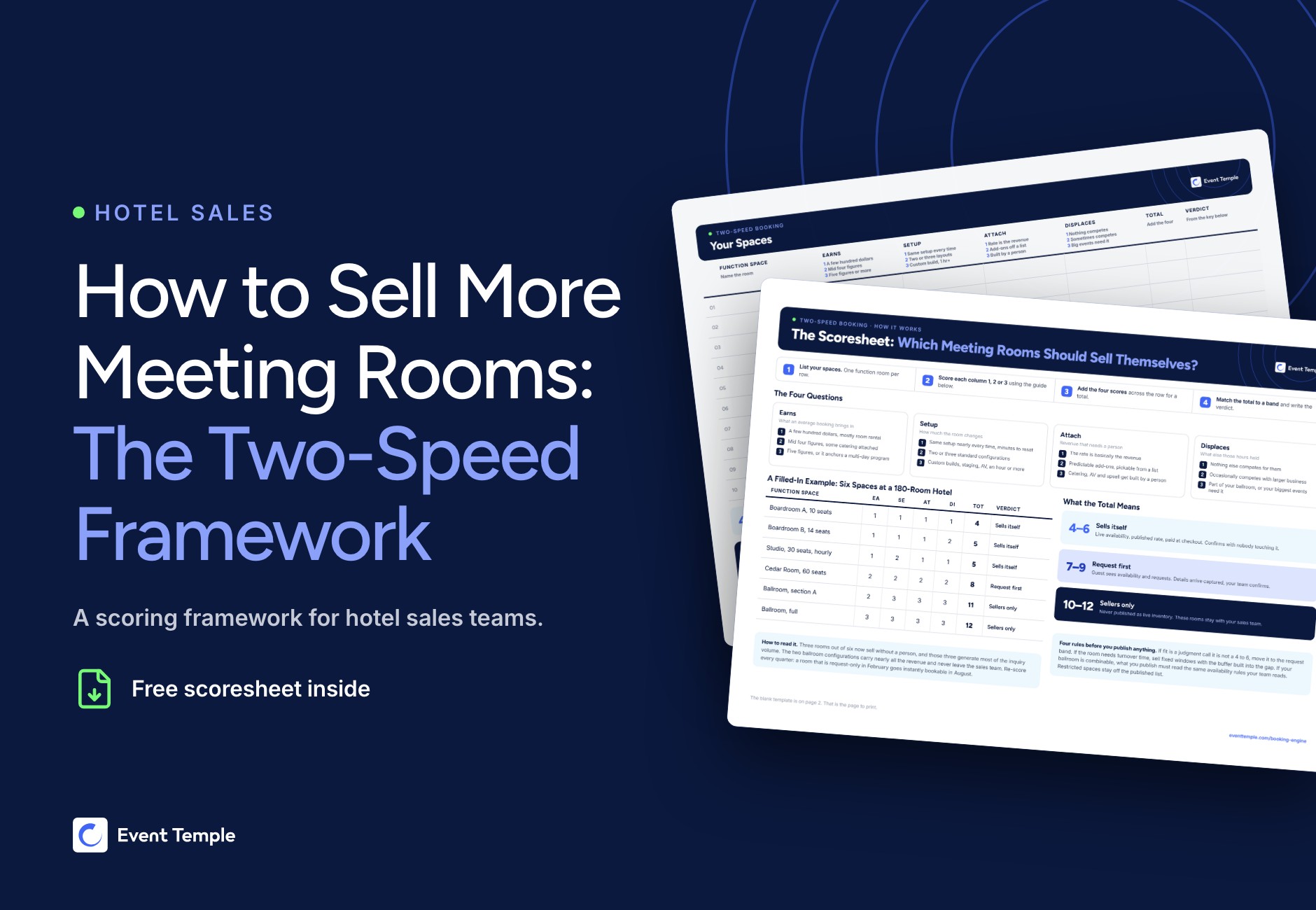
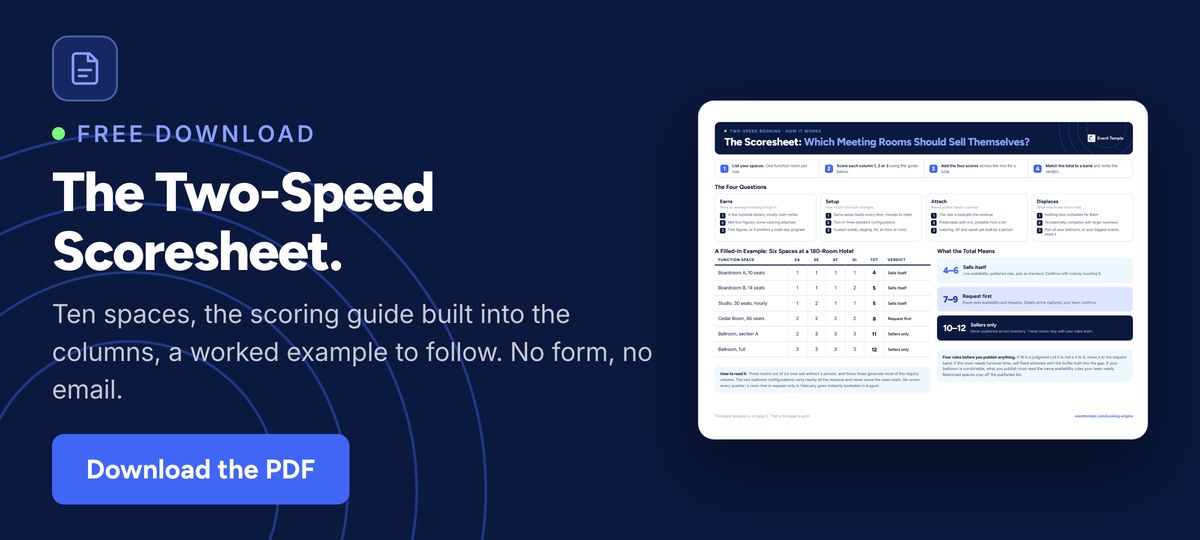
Pull your function space list. For each room, answer four questions, score each from 1 to 3, and add them up.
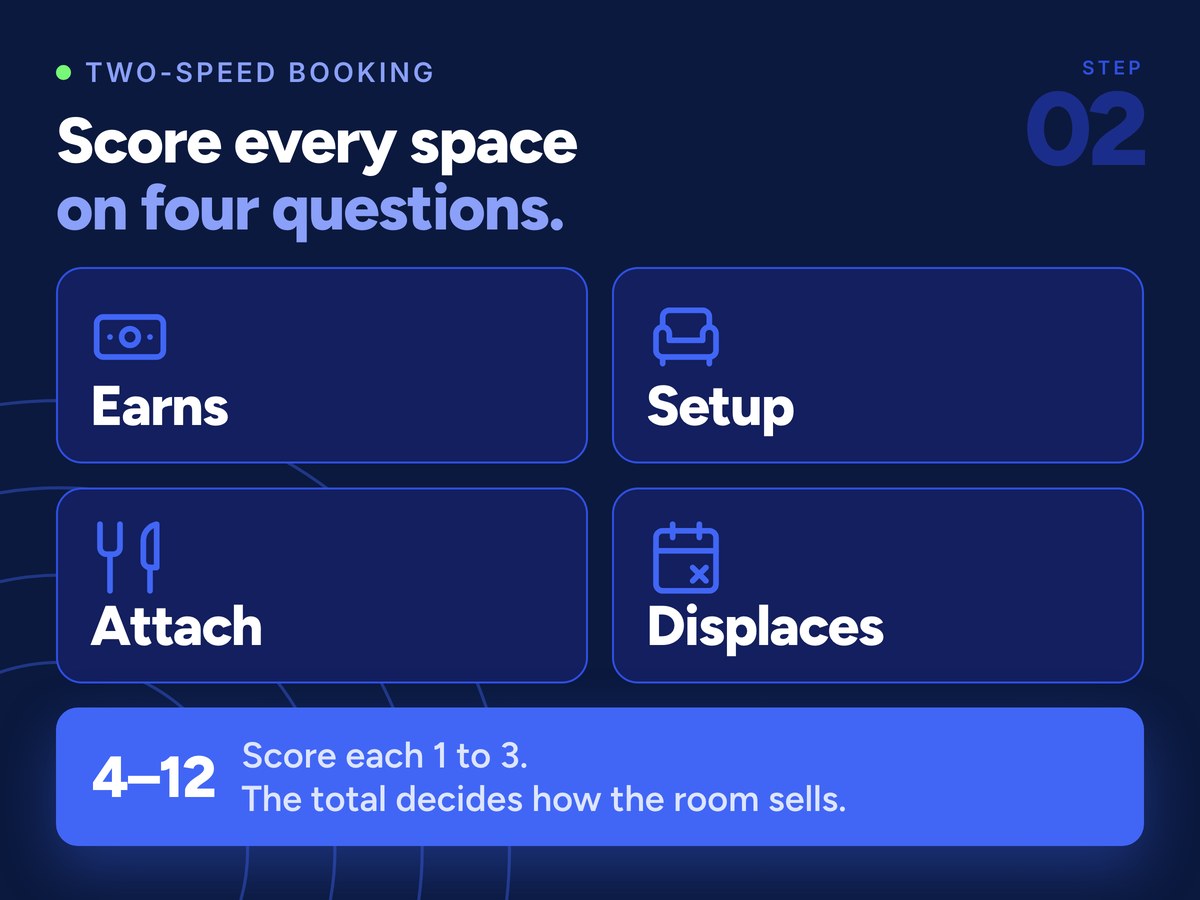
1. What does an average booking in this space earn?
- 1 point A few hundred dollars, mostly room rental
- 2 points Mid four figures, some catering attached
- 3 points Five figures or more, or it anchors a multi-day program
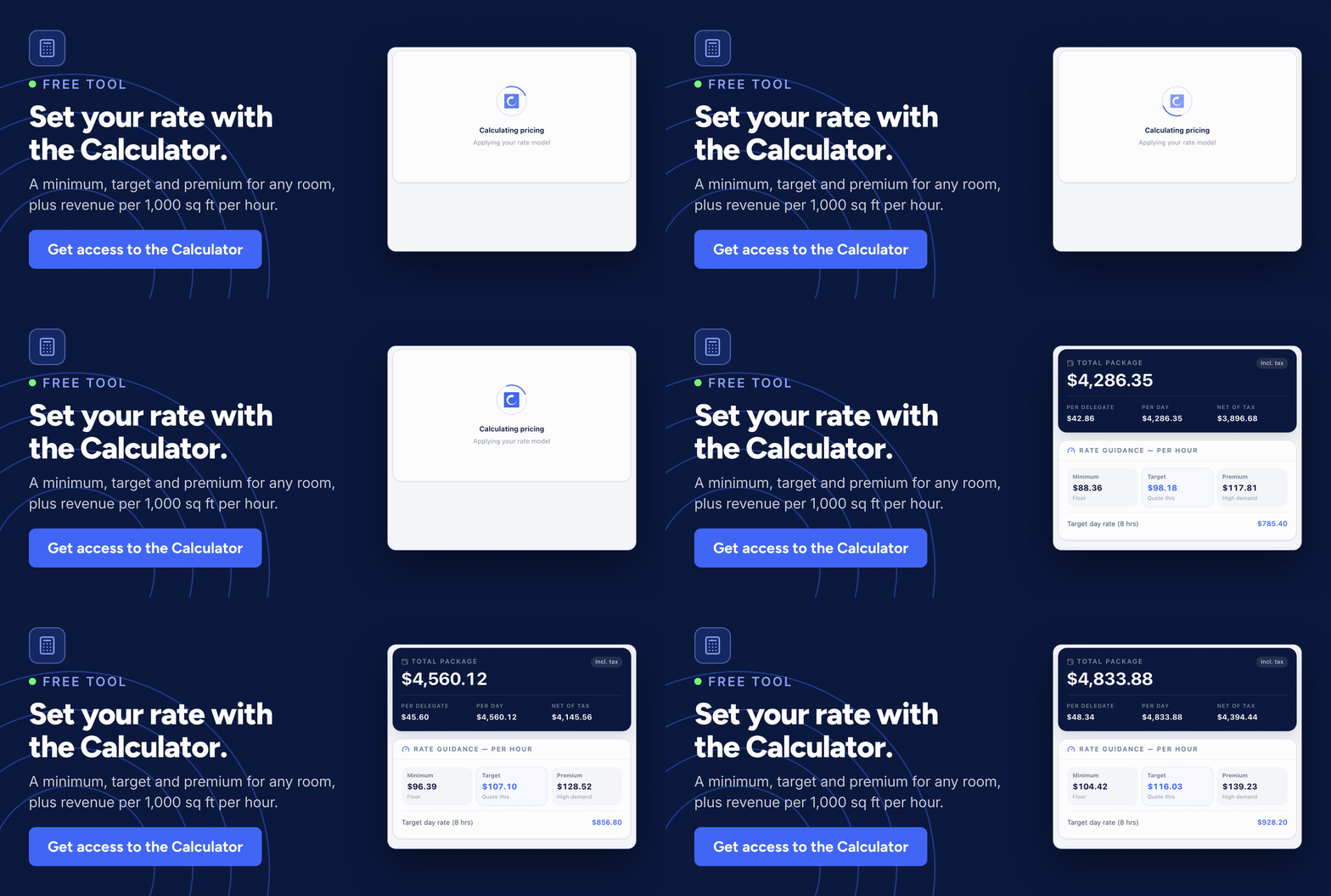
Two numbers turn this question from an argument into an answer. Our free meeting space pricing calculator returns a rate band for any room you feed it: a minimum you should walk away below, a target to quote, and a premium for compressed dates. It is free, you get access as soon as you request it, and you do not need to be an Event Temple customer to use it. It also reports revenue per 1,000 square feet per hour, which is the honest way to compare a boardroom against a ballroom. Run three or four rooms through it before you score anything.
2. How much does the space change between bookings?
- 1 point The same setup nearly every time, minutes to reset
- 2 points Two or three standard configurations
- 3 points Custom builds, staging, AV, an hour or more of turnover
3. How much of the revenue depends on a conversation?
- 1 point The rate is basically the revenue
- 2 points Predictable add-ons a guest could pick from a list
- 3 points Catering, AV and upsell get built through a person
4. What else could those hours have held?
- 1 point Nothing else competes for them
- 2 points Occasionally competes with larger business
- 3 points It is a component of your ballroom, or the room your biggest events need
That revenue-per-square-foot-per-hour figure earns its keep here too. A room that looks small on headline rate can out-earn a much larger space for every hour it occupies, which changes what you are willing to risk on it.
What Your Scores Are Telling You
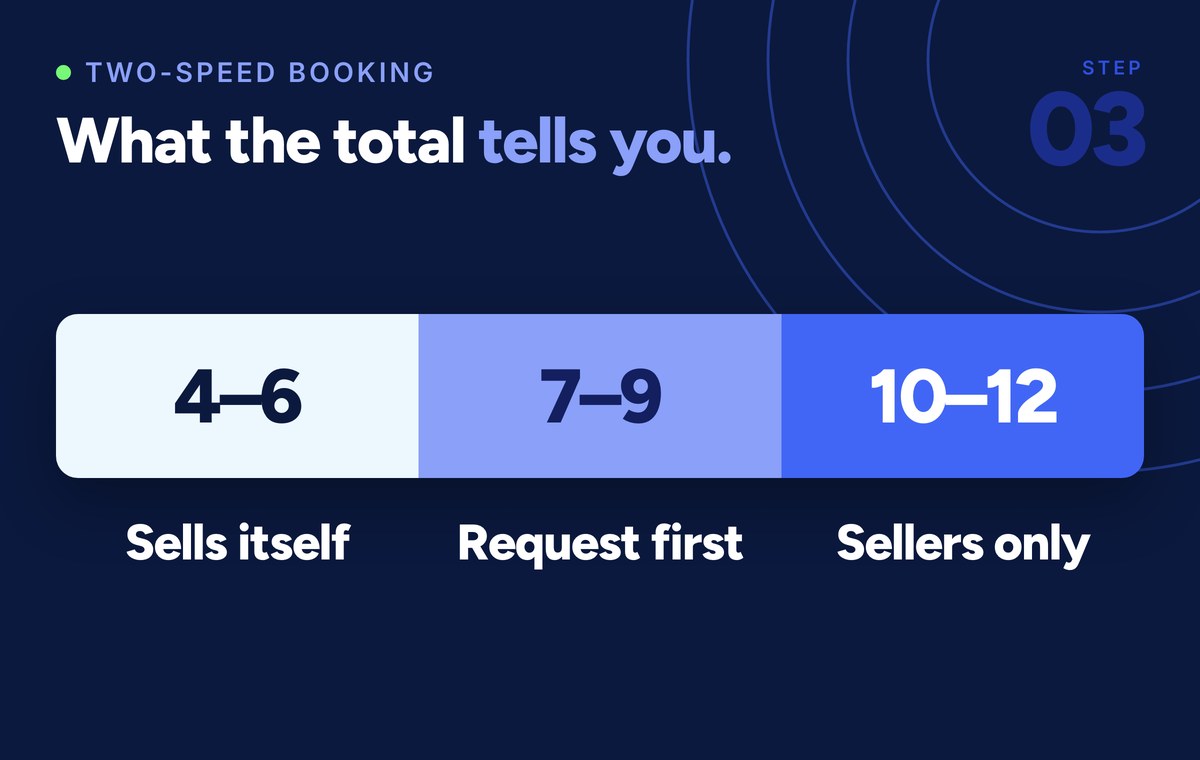
4 to 6: let it sell itself. Live availability, a published rate, payment at checkout, confirmed without anyone touching it. Publish at your target rate and know your walk-away floor before you do, because nobody is reviewing that number at 11pm on a Sunday.
7 to 9: publish it, and let your team confirm. The guest sees the space and the availability, then submits a request. The details arrive already captured. Your team decides whether to take it.
This middle band is where most hotels will put most of their inventory, and it is the more valuable half of the exercise. You are still capturing the Sunday-evening planner. You are still cutting three days of back-and-forth down to one decision. You have given up nothing.
10 to 12: keep it with your sellers. Do not publish live inventory for these rooms.
Nothing here is permanent. A room that is request-only in February goes instantly bookable in August. A room that becomes your flagship comes off instant booking the week it does.
A Worked Example: Six Spaces at a 180-Room Hotel
- Boardroom A, 10 seats — earns 1, setup 1, attach 1, displaces 1. Total 4, sells itself.
- Boardroom B, 14 seats — earns 1, setup 1, attach 1, displaces 2. Total 5, sells itself.
- Studio, 30 seats, hourly — earns 1, setup 2, attach 1, displaces 1. Total 5, sells itself.
- Cedar Room, 60 seats — earns 2, setup 2, attach 2, displaces 2. Total 8, request to book.
- Ballroom, section A — earns 2, setup 3, attach 3, displaces 3. Total 11, sellers only.
- Ballroom, full — earns 3, setup 3, attach 3, displaces 3. Total 12, sellers only.
Three rooms out of six now sell without a person. Those three also generate most of the inquiry volume, because small and repeatable is what small and repeatable means. The two ballroom configurations carry nearly all the revenue and never leave your sales team.
The Objections Your Team Will Raise, and What to Do About Each
When we walked hotels through this on the June webinar, the same four questions came back every time. They are good questions.
"Guests will pick the wrong room." This comes almost entirely from properties with large or varied floor plans, and it is real. It is also a scoring problem rather than a software problem. If fit is a judgment call, the space is not a 4 to 6. Put it in the request band, or sell it as a package that arrives as an inquiry, and let your team place it in the room that actually works. If you are building those packages now, the calculator prices them per delegate and per day, which is the shape most corporate buyers compare on.
"We need turnover time between bookings." Then stop selling those rooms by open hourly selection. Sell fixed windows instead: half-day morning, half-day afternoon, full day, with the turnover built into the gap between them. The guest picks a window and the buffer becomes structural instead of something a coordinator has to remember.
"Our ballroom splits into sections." Then whatever you publish has to read the same availability rules your team reads, combinable spaces included. Section A sells, the full ballroom disappears from availability in the same second. Test this before anything else. It is the hardest requirement on the list and the one most likely to be handled badly.
"Some spaces need permission to book." Keep them off the published list, or gate them behind member and corporate access so only approved accounts can see them.
Every one of these is solved by moving a room into a more conservative band. None of them is a reason to keep all six rooms behind a salesperson.
What Selling at Two Speeds Adds Up To
Your sellers get hours back. Summer Putnam, Corporate Director of Sales at Sunridge Hotel Group, puts the gain at three to eight hours per rep per week after moving to Event Temple: "That is three to eight hours of relationship building instead of admin, every single week." Taking your smallest bookings off the queue entirely compounds it.
Demand you could not count becomes visible. Once the Sunday-evening planner has a way to convert, they show up in your reports for the first time. You can finally price against a number instead of a suspicion.
One pipeline instead of two. Whatever you sell online has to land beside everything your team sells by hand, tagged with its source. Solve the workflow but create a reporting problem and you have only traded one headache for another.
The revenue follows. Prestige Hotels & Resorts reports a 10 to 15% revenue increase across nineteen properties. Those gains come from exactly this kind of reallocation: less admin, faster response, more selling time aimed at the business worth selling.
The industry is moving here with or without any single property. Hyatt is rolling out instant group booking through its Groups360 partnership, putting real-time meeting space availability in front of planners across a global portfolio. Planners who get that experience once start expecting it from everyone, independents included. The properties that decide deliberately which rooms sell themselves meet that expectation without giving up control of the spaces that matter.
Start With the Scoring, Then Get the Software
Run the four questions across your function space list this week. Twenty minutes, one page, no budget approval. Most hotels find two or three rooms land in the 4 to 6 band, a handful sit in the middle, and their revenue-critical spaces score right where they expected. That one page is your online selling strategy, and you built it before evaluating any software at all.
Then go get the software that matches it. The Event Temple Booking Engine is built around this exact split: every space carries its own mode, instant book or request to book, set per room and switchable whenever your strategy changes. It reads live availability from Event Temple before confirming anything, so a space that is held, blocked or already sold is never offered. Instant bookings and requests both land in your pipeline with source, details and payment attached. Bring your scoresheet to a demo and our team will map it to your floor plan, room by room.